
When Project Plans Change: Leading Across Scope, Schedule, and Cost
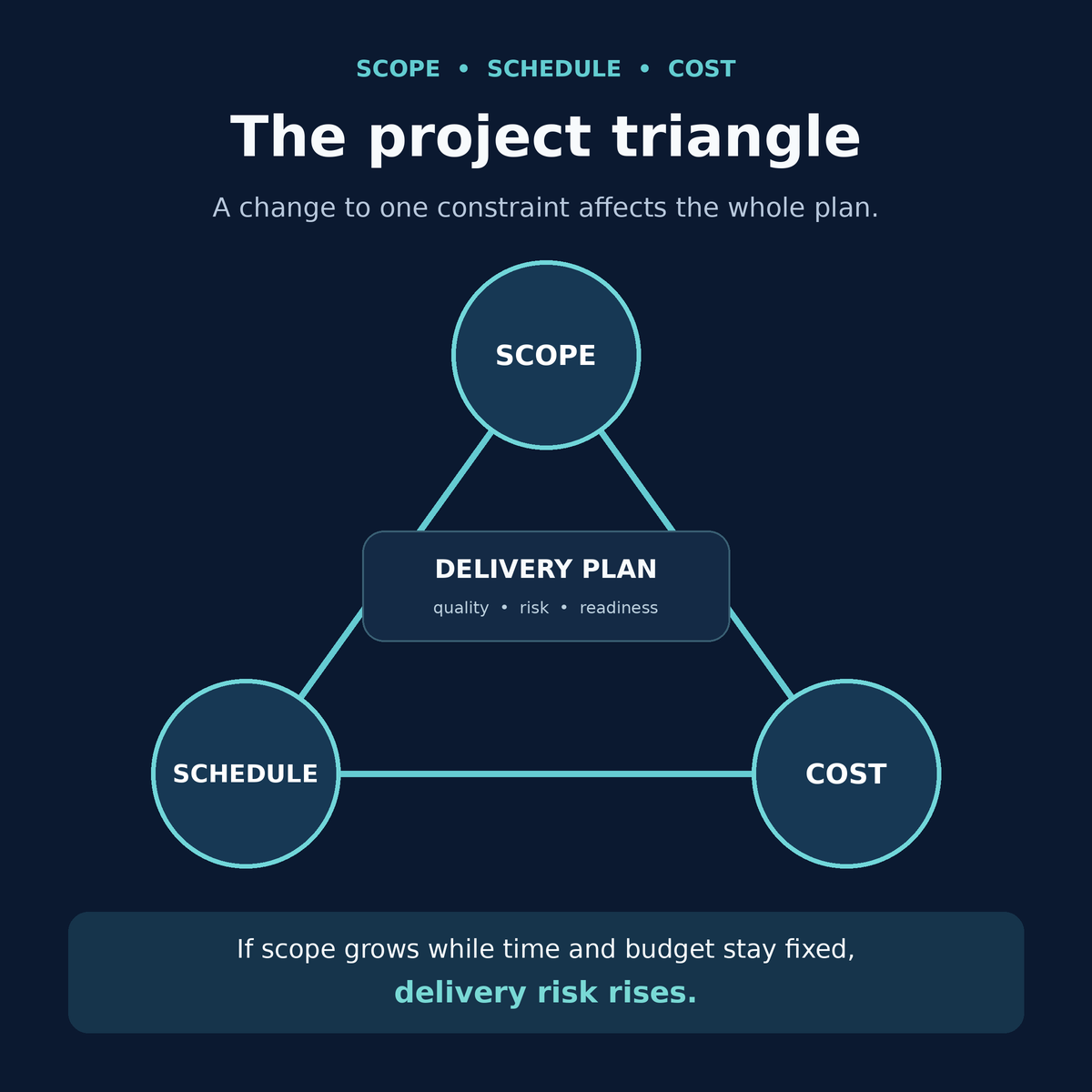
Every project begins with a plan. It defines what will be delivered, when it will be delivered, and the resources available to do the work. Those three considerations—scope, schedule, and cost—form the familiar project management triangle.
The triangle is simple enough to fit on a slide. Managing it in a live project is anything but simple.
Priorities change. A customer needs a new capability. A deployment site becomes available earlier than expected. An organization decides to adopt a different technology. Each may be a sound decision. The challenge is understanding how that decision affects work already planned or underway.
Strong project leadership makes those effects visible before turning a new direction into a new promise.
A deadline is a constraint, not a complete plan
A firm delivery date can focus a team. It helps people prioritize, resolve issues quickly, and organize work around a shared objective. But a date alone does not tell the team which requirements matter most, what dependencies must be met, or how changes will be handled.
Consider a project whose launch date must remain fixed. Midway through delivery, stakeholders request additional features and a change to the rollout sequence. The requests may improve the final product. They may also require new design work, testing, training, coordination, or approvals.
The project manager’s role is to connect those requests to their consequences. Which work can be completed before launch? What could be delivered in a later phase? What support would help? What risks would the organization take on by keeping the original plan?
Those are decisions for project sponsors and leaders to make with the team. They are difficult to make well if the schedule is treated as independent of the work.
Look beyond the change itself
A change that appears small in a meeting can reach across an entire project. Moving one deployment date may affect staff assignments, customer readiness, vendor availability, training, and the sequence of later sites. A design change may trigger integration work and another cycle of testing. A new requirement may affect both.
Before approving a significant change, ask the people doing the work to assess:
Scope: What is being added, removed, or changed? What existing work will need to be repeated?
Schedule: Which dependencies and milestones move? How much contingency remains?
Cost and capacity: Are the necessary people, skills, and funding available when the work must happen?
Quality and readiness: What testing, training, support, or operational preparation is required?
Risk: What becomes less certain, and what would happen if an assumption proves wrong?
This assessment is the groundwork for carrying out a change successfully.
Bring leaders choices they can act on
“We cannot meet the date” may be an important conclusion, but leaders still need to understand their options. A useful assessment shows the paths available and the tradeoffs each requires.
For example, the team might be able to preserve the launch date by delivering the essential capability first and scheduling the new feature for a later release. Another option may require more specialized support, with time allowed for those people to become productive. A third may keep the full scope but move the launch date to account for design, testing, and deployment work.
None of these options is free of consequences. Adding people does not automatically shorten every task; some work must happen in sequence. Reducing scope may affect the value stakeholders expect. Extending a schedule may affect other commitments. The purpose of presenting options is to help leaders choose deliberately, with a clear view of the impact.
When leadership makes a choice, the project manager should update the plan, document the assumptions and decision, and explain the new priorities to the team. A change is not fully managed while the team is still working from an outdated baseline.
Protect the information a team needs to succeed
People closest to delivery often see problems first. Engineers know which components depend on one another. Deployment teams know what it takes to prepare a site. Operations staff know what must be in place to support a system after launch.
Project leaders should create space for that knowledge to reach decision-makers early. Ask teams what a proposed change will require and where they see uncertainty. Then communicate the decision back to them, including what was prioritized, what was deferred, and why.
Clear communication matters particularly when a project is under pressure. If people receive shifting instructions without a shared explanation, they spend time reconciling competing priorities. Consistent direction helps them focus on delivery.
Use the triangle as a conversation starter
The scope, schedule, and cost triangle is useful because it prompts a practical question: If one part of the plan changes, what else must be reconsidered?
Teams can improve processes, find efficiencies, and solve problems creatively. The triangle reminds leaders to examine the effect of change rather than assume the original commitments still hold.
Successful project management means making informed decisions, keeping the plan credible, and giving the people responsible for delivery the clarity and support to do their work.
Ambitious goals deserve that level of discipline. It is how organizations turn a desired outcome into a result they can stand behind.
